The Veneto Region hosts 9 World Heritage sites, mostly easily reachable from Villa Tiepolo Passi, thanks to the strategic position Treviso enjoys between the mountains and the sea, next to trains, freeways and motorways (A27 Venezia-Cortina).
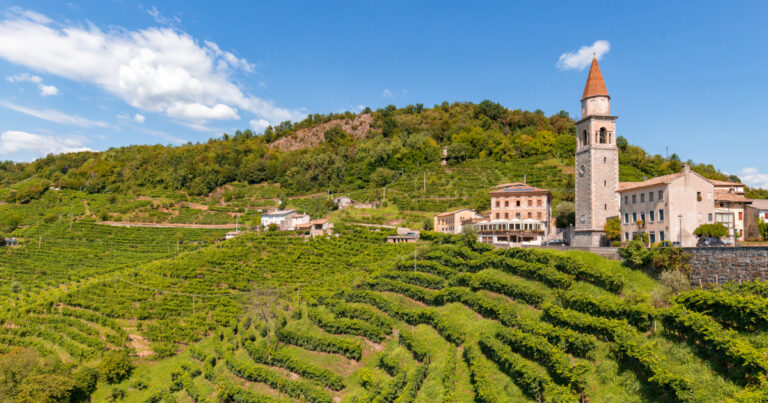
The Prosecco Hills of Conegliano and Valdobbiadene
With a worldwide known brand, wine-grape cultivation has ancient origins here: the first written mention linking Prosecco to this territory dates to 1772. Various panoramic itineraries allow visitors to discover this sublime example of “cultural landscape”, enriched with refreshing tastings and pleasant boroughs.
Venice and its lagoon
Choosing Treviso does not exclude a visit to Venice, approachable by car or comfortably by train, and to its islands, the most famous Murano, Burano and Torcello. The coastal basin of the lagoon is more than 70,000 hectares between the mouths of the river Brenta and the river Sile. From Treviso, you can bike along the greenway of the Natural Park of the river Sile (GiraSile) reaching the lagoon in Portegrandi, through the Altino archeological site and, maybe, up to the seaside (Jesolo).
Venetian Villas
Although only the 24 Palladian Villas, together with the city of Vicenza, have been prized by UNESCO, Venetian Villas represent an extraordinary ensemble preserving the history of the relationship between Venice and the Mainland. Starting from Villa Tiepolo Passi with a guided tour revealing the history and the essence of such a civilization – available at special prices for Foresteria guests – you will be ready for a tour delving into the historical, cultural, landscape and artistic values of so many and different villas.
Padua
A city with a historical, artistic and religious importance (hosting the Basilica of St. Anthony of Padua, among the main pilgrimage destinations), Padua has two world heritage sites: the Botanical Garden of the historic University, the most ancient in the world, and a group of frescoed chapels and halls gathered under the name Padova Urbs Picta, celebrating the great 14th-century artistic development that the city experienced thanks to Giotto, whose Scrovegni Chapel is regarded as the most extraordinary and revolutionary masterpiece in medieval art.
The Dolomites
Famous for their sculptural shapes and the pink colour they assume at sunset, the Dolomites can appeal visitors either during the winter, with ski areas, or in the summer, for biking and trekking excursions. Founded in 1990, the Natural Park of the Ampezzo Dolomites covers an area of more than 11.000 hectares with alpine lakes, mountain huts, vie ferrate trails and rope-assisted trails, some of which pass through Great War sites.
Have a look also at the beauty of the Veneto pre-Alps, so called Pedemontana, rich in historic towns and trekking paths.