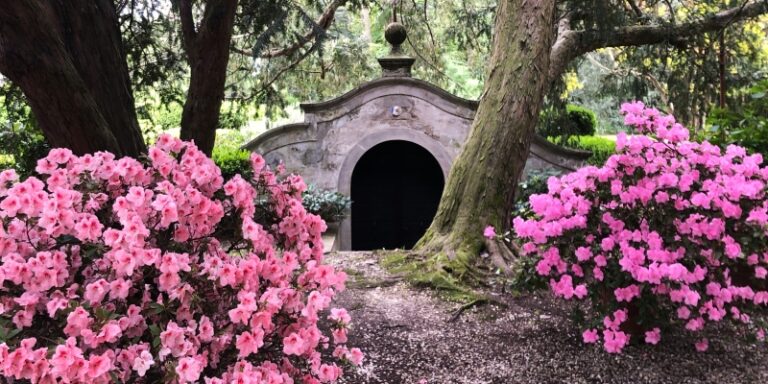
The Venetian Villa has two parks: the noble park and the rustic park.
The Noble Park is the pleasure garden, according to a late and decadent fashion, mostly from the 18th and 19th century, and is essentially unproductive. It is rare in 16th- and 17th-century villas of the heroic age. Here we find the geometric rigor of the Italian topiary garden, with boxwood and thuja, raked gravel, decorative vases, and a central fountain. Flanking this are the exotic triumphs of centuries-old tall trees, flowering borders and shrubs, and, in the Romantic English style, artificial mounds, grottos, and reflective water features.
The Rustic Park, by contrast, is primarily characterized by cultivation. It is the villa’s original park—at the time, an entirely new landscape—the well-ordered countryside (in Palladio’s words). Various areas, all useful and productive, form distinct biotopes.
Lining the fields of wheat, corn, permanent meadows and tree rows, we find dense hedges of native species—shelter for birds and beneficial insects that prey on crop pests; hornbeam hedges serve as windbreaks, while riparian plants along streams and in floodplains stabilize the banks.
Elms, plane trees, hornbeams, and a large boxwood hedge form the tree architecture of the roccolo di caccia (hunting grove), once a source of animal protein, now a birdwatching area. Cypress trees, Italian poplars, and maritime pines frame the main avenues and the villa’s north-south perspective avenues.
Different cultivars of fruit trees, arranged in neat rows, grow in the brolo (walled orchard); mulberries and bamboo thickets, reminders of the time when silkworms were raised, can still be found in the broletto, once also home to poultry and small livestock. The vegetable gardens provide seasonal produce, as well as cut flowers to brighten the villa’s dining tables.
All of this, enhanced thanks to the European Union’s Next Generation funding initiative—is preserved at the villa as a guarantee of memory: that is, of history, culture, biodiversity, and global ecology.
© Alberto Passi
All rights reserved.